
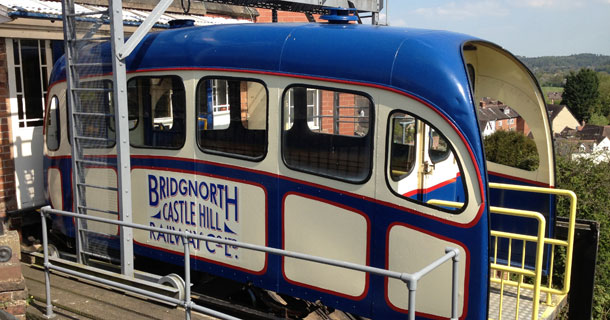
The Bridgnorth Cliff Railway or Castle Hill Railway is a funicular cliff railway in Bridgnorth
The railway links the High Town and Low Town areas of Bridgnorth. The track length is 201 ft (61.2 metres)
The railway was opened on 7 July 1892 by Mayor John Anderson. A public holiday was proclaimed to celebrate the occasion.
Originally the railway was powered by a simple system using water and gravity. Water was pumped into a 2000 imperial gallon (9000 litre) tank beneath the top car until its weight
Between 1943 and 1944 the system was rebuilt to use electricity
In 1955 the original heavy wooden cars were replaced by the ‘up-to-date’ stronger and lighter (5.4 long tons).
The rails were replaced in about 1972 with the bullhead design formerly used on mainline railways. The track gauge is 3 ft 6 in (1067 mm).
6A Castle Terrace Bridgnorth WV16 4AH
tel :: 01746 762052
Bridgnorth Cliff Railway sold to family firm
Monday 22nd August 2011
The Bridgnorth Cliff Railway has been sold to a family of Suffolk-based property developers
Local operators Allan and Jean Reynolds put the Bridgnorth Castle Hill Railway Company
Mrs Reynolds said the railway had been sold to the Tipping family
She said: We are delighted to announce the company has been sold to another family
We have a great deal of confidence in the new owners. Our plan is now to retire
Jonathan Bengough said: The railway went on to the market in February and attracted a tremendous amount of interest from all four corners of the UK.
We are very happy a family interest who have purchased the company. They will treasure it as much as the Reynolds have done for 15 years.
The Tipping family are established property investors with real estate interests in different parts of the country.
Eileen Tipping said: “This is a very exciting opportunity for our family. We have had long associations with Hong Kong and see this purchase as a chance to own our own mini version of Hong Kong’s famous Peak Tram.”
Malvern Tipping added: Not only is the cliff railway an extremely important part of our historic transport heritage
Source: Wikipedia